


GHK-Cu: The Copper Peptide Rewriting the Rules of Skin Longevity

A deep-dive into one of skincare’s most compelling bioactive ingredients; where it comes from, what it does, and why it matters.
What Exactly Is GHK-Cu?
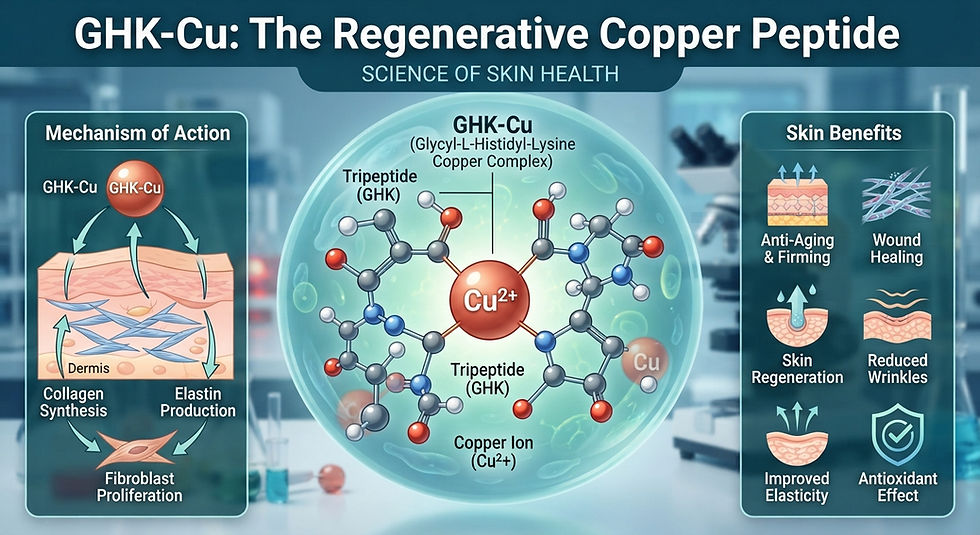
GHK-Cu is a naturally occurring tripeptide; a chain of three amino acids: glycine, histidine, and lysine, bound to a copper (Cu²⁺) ion. Its molecular weight is approximately 404 g/mol, which places it on the smaller end of the bioactive peptide spectrum. On a cosmetic ingredient label, you will find it listed by its INCI designation: Copper Tripeptide-1. If a product claims "copper peptide complex" without that specific name, a degree of skepticism is warranted.
Dr. Loren Pickart first identified GHK in 1973 while studying factors in human plasma that promoted liver tissue regeneration. What he discovered was that plasma from young adults dramatically outperformed plasma from older adults in stimulating hepatocyte function, and that GHK was a significant part of why. The age dimension of this molecule has remained central to its scientific story ever since. In young adults around age 20, plasma concentrations of GHK sit at approximately 200 ng/mL. By age 60, those levels have declined to roughly 80 ng/mL; a drop that correlates, non-coincidentally, with the well-documented reduction in tissue repair capacity that defines skin aging.
The copper component of GHK-Cu is not decorative or incidental. It is functionally essential. Copper (Cu²⁺) serves as a cofactor for several enzymes that are indispensable to skin structure and defense. Lysyl oxidase, which crosslinks collagen and elastin fibers to give them tensile strength and elasticity, is copper-dependent. Superoxide dismutase, the body's primary enzymatic antioxidant, responsible for neutralizing the superoxide radicals that accumulate with age and UV exposure, is also copper-dependent. GHK functions as a physiological copper transporter, shuttling Cu²⁺ ions directly to sites of tissue injury and cellular stress, where these repair enzymes need it most. The peptide, in other words, is a delivery vehicle for an essential biological cofactor, not merely a signaling molecule in its own right.
What GHK-Cu Does in the Body; Its Biological Role
GHK-Cu is endogenous, meaning the body produces it naturally in response to tissue injury and cellular stress. It functions as a biological repair signal, released at the site of damage to coordinate the complex cascade of healing. Understanding this context matters enormously, because it means topical application of GHK-Cu is not asking the skin to do something foreign. It is amplifying a process the skin already knows how to run.
In the dermis, the primary target cells are fibroblasts, the structural workhorses responsible for synthesizing collagen, elastin, and the glycosaminoglycans that maintain skin's hydration and volume. GHK-Cu stimulates fibroblast activity at concentrations as low as 0.01 to 100 nanomolar, which is an extraordinarily low threshold. This is not brute-force chemistry; it is precision signaling.
What makes GHK-Cu particularly sophisticated is its role in matrix remodeling. Rather than simply driving up collagen production indiscriminately, it simultaneously stimulates new synthesis of Type I and Type III collagen, elastin, and glycosaminoglycans, including decorin, a proteoglycan critical to collagen fiber organization, while also intelligently regulating matrix metalloproteinases (MMPs), the enzymes responsible for breaking down old and damaged extracellular matrix. This dual action, build new & clear old, is what separates true tissue renewal from mere collagen accumulation. Skin that has been remodeled looks and behaves differently from skin that has simply been stimulated to overproduce; the architecture matters as much as the volume.
The scope of GHK-Cu's influence at the genetic level is extraordinary. Analysis using the Broad Institute's Connectivity Map found that GHK influences the expression of approximately 4,000 human genes, roughly 31% of the genes tested, with the vast majority shifted in health-positive directions: upregulating pathways governing DNA repair, antioxidant defense, anti-inflammatory signaling, and collagen synthesis, while downregulating those associated with inflammation and cellular senescence.
As a redox-active molecule, GHK-Cu cycles between Cu²⁺ and Cu⁺ oxidation states, conferring a superoxide dismutase-like antioxidant effect. This means the peptide-copper complex can directly neutralize reactive oxygen species (ROS); the free radicals generated by UV radiation, pollution, and normal metabolic processes that drive photoaging at the cellular level. The anti-inflammatory mechanism operates through a similarly fundamental pathway: GHK-Cu suppresses NF-κB, the master transcription factor that drives production of pro-inflammatory cytokines including IL-1β, IL-6, and TNF-α. Chronic low-grade elevation of these cytokines is one of the core mechanisms of inflammaging; the slow, persistent inflammatory process that accelerates visible skin aging over time.
GHK-Cu also upregulates VEGF (vascular endothelial growth factor), promoting angiogenesis, the formation of new blood vessels, which improves the delivery of oxygen and nutrients to dermal tissue. And it was among the first bioactive peptides shown to accelerate wound healing across multiple tissue types, including skin, bone, gastrointestinal mucosa, and hair follicles.
"GHK-Cu doesn't just signal the skin to make more collagen. It acts like a biological reset, recalibrating gene expression, clearing damaged matrix, and redirecting cellular energy toward regeneration."
How GHK-Cu Works on the Skin; The Topical Story
The Penetration Question
The skin's stratum corneum is a selective barrier, and for good reason. It is the first line of defense against pathogens, irritants, and environmental insult. Any honest discussion of a topical active ingredient must address how much of it actually crosses that barrier and reaches its target cells in the dermis.
GHK-Cu's molecular weight of approximately 404 g/mol places it at a meaningful advantage relative to larger peptides. The traditional "500 Dalton rule", the widely cited threshold below which passive dermal penetration becomes meaningfully possible, positions GHK-Cu on the favorable side of that line. An ex vivo cadaver skin study quantified penetration directly: a permeability coefficient of 2.43 ± 0.51 × 10⁻⁴ cm/h, with the stratum corneum accumulating 438 times baseline copper concentration, and 97 μg/cm² retained in skin layers after 48 hours. The researchers concluded that topical Copper Tripeptide-1 may offer an effective alternative to injection for local delivery; a meaningful finding, though one that deserves the caveat that ex vivo models do not perfectly replicate living skin dynamics.
Penetration is formulation-dependent. Vehicle chemistry, pH (optimal between 5 and 7), and encapsulation technology all significantly influence how much active ingredient reaches dermal fibroblasts. A GHK-Cu ingredient in a poorly designed formula, at the wrong pH, in clear glass packaging, is not the same product as one formulated with delivery in mind. Some clinicians apply GHK-Cu serums immediately following micro-needling to enhance transdermal delivery by bypassing the stratum corneum mechanically, a practice with a compelling rationale, though large randomized controlled trial data on this specific combination remain limited.
The Clinical Evidence
The evidence base for topical GHK-Cu is substantial relative to most cosmetic actives, though it is important to characterize it honestly. The mechanistic data from cell culture, animal models, and gene expression studies is exceptionally strong and consistent. Human clinical trial data, while growing, remains more limited in scale.
The foundational work came in 1988, when Maquart et al. published a landmark fibroblast study demonstrating that GHK-Cu stimulates collagen synthesis in cultured human dermal fibroblasts at nanomolar concentrations; dose-dependent stimulation beginning at 10⁻¹² M, with maximum effect at 10⁻⁹ M. This established the mechanistic basis for everything that followed.
In subsequent comparative studies, GHK-Cu improved collagen production in approximately 70% of participants over 12 weeks; a figure that compared favorably to vitamin C (approximately 50%) and retinoic acid (approximately 40%) under similar conditions. Work comparing GHK-Cu to Matrixyl 3000, one of the most widely used peptide complexes in premium skincare, found GHK-Cu produced a 31.6% greater reduction in wrinkle volume, a clinically meaningful difference.
Kruger et al. confirmed increased skin thickness (across both epidermis and dermis), improved hydration, increased skin elasticity, and increased Type I collagen production with twice-daily GHK-Cu application. A two-RCT review (Pickart and Margolina, 2024) examined a larger trial of 71 women with mild to advanced facial photoaging over 12 weeks, showing enhanced skin density, reduction in fine lines, and improved wrinkle depth, alongside a smaller trial in 41 women with periorbital photodamage, where GHK-Cu outperformed both placebo and vitamin K controls.
The wound-healing literature is particularly compelling. Mulder et al. (1994) conducted a multicenter randomized controlled trial in diabetic ulcer patients, where a GHK-Cu gel achieved 98.5% median wound area closure versus 60.8% in controls, and an infection rate of just 7% in treated patients compared to 34% in the control group. These are not cosmetic outcomes; they are hard clinical endpoints.
The honest caveat: most cosmetic trials of GHK-Cu involve modest sample sizes, and large randomized controlled trials in purely aesthetic indications remain limited. What the evidence base offers is a consistent mechanistic signal across multiple study designs and tissue types; which, in the clinical evidence hierarchy, carries real weight even where individual studies have sample size constraints. A 2026 systematic review in the Aesthetic Surgery Journal (20 studies, including 2 RCTs) concluded that GHK-Cu demonstrates a reasonable biological basis for use as a regenerative agent, while correctly noting that larger, standardized trials are needed to close the translational gap.
What to Look for on the Label
When evaluating a GHK-Cu product, the following considerations are the difference between an effective formulation and an expensive hope:
INCI name: Copper Tripeptide-1. This is the standardized cosmetic designation. Vague references to "peptide complex" or "copper extract" without this specific name should be viewed skeptically.
Concentration: Published studies have produced meaningful results at approximately 1-5%. Concentrations listed far down an ingredient deck, after preservatives and fragrance, raise reasonable questions about efficacy.
Packaging: GHK-Cu is sensitive to light and air oxidation. An opaque, airless pump is not a styling choice, it is a stability requirement.
pH: The optimal range is 5-7. Lower pH can destabilize the copper-peptide complex before it reaches the skin.
Timing with acids: Strong AHAs or BHAs used at the same time of day can degrade the peptide at the skin surface. Stagger application; exfoliating acids in the morning, GHK-Cu in the evening to protect stability and maximize benefit.
Injectable vs. Topical GHK-Cu; Understanding the Difference
It would be a disservice to ignore the fact that injectable GHK-Cu exists as a topic of growing conversation, particularly in wellness and longevity communities. A clear-eyed, medically honest account serves everyone better than silence.
Injectable GHK-Cu, administered subcutaneously or intradermally, bypasses the stratum corneum entirely, delivering the peptide systemically with high bioavailability. The mechanism is scientifically compelling in principle: if GHK-Cu exerts regenerative effects at nanomolar concentrations in tissue, delivering it directly into systemic circulation removes the formulation and penetration variables that complicate topical use.
However, the evidence picture for injectable GHK-Cu is considerably less developed than for topical use. There are currently no large, peer-reviewed human randomized controlled trials for injectable GHK-Cu in cosmetic or anti-aging indications. The evidence comes primarily from preclinical (animal) models and small observational reports. The absence of this data matters enormously in any responsible assessment.
Regulatory status is equally important to understand. Injectable GHK-Cu is not FDA-approved for any indication. It is available through 503A compounding pharmacies with a physician prescription in some jurisdictions, or marketed openly as a "research compound", a designation that implies no regulatory review of safety, purity, or efficacy for human use. The legal and safety landscape differs substantially from the regulated cosmetic topical category.
Copper load is a practical consideration for anyone evaluating extended injectable protocols. A standard 1–2 mg injectable dose contains approximately 7-14 mcg of elemental copper, modest relative to the 900 mcg/day RDA at standard doses, but cumulative copper exposure without cycling warrants monitoring. Injectable use is a medical decision, not a skincare decision, and it requires physician oversight, contraindication screening, and appropriate monitoring throughout.
Altara works exclusively with topical formulations; the route supported by the strongest controlled human evidence, the most favorable regulatory standing, and the best-understood safety and tolerability profile. Injectable peptide use falls outside our scope and should always be a conversation held with a qualified physician.
Safety Profile; What You Should Know
Because GHK-Cu is an endogenous peptide, one the body naturally produces and circulates, it carries an inherently favorable tolerability profile. The skin is not encountering a foreign molecule; it is encountering something its own biology already recognizes and responds to.
In cosmetic clinical studies, adverse events are typically mild and transient. Approximately 5-10% of users report mild irritation or erythema, and these reactions are generally attributed to carrier and formulation components rather than GHK-Cu itself. There is no evidence in the published literature of hormonal disruption, immune suppression, or systemic toxicity at topical doses.
True allergic reactions to GHK-Cu itself are rare; when they do occur, they are typically traced to formulation excipients. There is no photosensitivity risk associated with GHK-Cu — no need to adjust sun protection habits or limit daytime use on that basis.
Two contraindications deserve explicit mention. Wilson's disease, a genetic disorder of copper metabolism, is a strict contraindication for any copper-containing product. Anyone with a known copper metabolism condition should disclose it to a healthcare provider before use. As a general precaution, topical GHK-Cu is not recommended during pregnancy or breastfeeding pending dedicated safety data in these populations; not because harm has been demonstrated, but because the data does not yet exist to confirm safety with certainty.
The timing interaction with exfoliating acids noted earlier bears repeating here: AHAs and BHAs used simultaneously with GHK-Cu can degrade the peptide complex at the skin surface. Staggering application, acids in the morning, GHK-Cu in the evening, resolves this entirely.
Among cosmetic actives with meaningful evidence behind them, GHK-Cu stands out for its absence of the drawbacks that complicate alternatives: no purging, no photosensitivity, no required downtime, and no retinoid-style adjustment period. The benefit-to-risk profile, assessed honestly, is among the most favorable available.
The Altara Perspective; Why We Use GHK-Cu
Altara does not formulate with ingredients because they are trending. Every active that appears in an Altara formula has passed a rigorous internal evidence review; one that asks not just whether a study exists, but what kind of study it was, how large, how controlled, and whether the signal has been replicated independently. Most ingredients do not clear that bar.
GHK-Cu clears it with room to spare. It is one of the most thoroughly studied bioactive peptides in the dermatological literature, with a research record spanning more than fifty years, across fibroblast culture, animal models, wound-healing RCTs, and human cosmetic trials. The mechanistic basis is understood at the genetic level. The clinical outcomes, where measured, are consistent. The safety record is excellent.
What draws us to GHK-Cu most fundamentally, however, is not just the depth of the evidence, it is the nature of what this ingredient does. It works in alignment with the skin's own biology. It does not override normal physiology or force an inflammatory cascade to achieve a result. It amplifies what the body already knows how to do: repair, renew, and regenerate. That philosophy, working with the skin rather than against it, is the foundation of every Altara formulation.
Copper Tripeptide-1 is formulated at meaningful concentrations, in delivery vehicles optimized for stability and penetration, in packaging that protects the active from light and air oxidation. This is the distinction between a product that contains an ingredient and one that delivers it.
At Altara, we believe your skin deserves ingredients with a real story; one rooted in decades of science, not seasonal marketing cycles. GHK-Cu has earned its place in clinical skincare, and we invite you to experience what thoughtfully formulated copper peptide technology can genuinely do. Explore the Altara collection and see the difference that evidence-led formulation makes.
ALTARA SKINCARE| Altara Beauty Ltd.
References: Pickart L (1973). Maquart FX et al. (1988). Mulder GD et al. (1994). Kruger P et al. (multi-year topical studies). Pickart L & Margolina A (2024, PMID 39963574). Systematic Review: Aesthetic Surgery Journal (2026, PMID 42619529). Gene expression: Broad Institute Connectivity Map analysis. Molecular data: PubChem CID 378611.
This article is for educational purposes and does not constitute medical advice. Consult a qualified healthcare provider for individual skincare guidance.



Comments